Mostrando entradas con la etiqueta influences. Mostrar todas las entradas

miércoles, 2 de noviembre de 2011

The Kiss of Judas


"The Kiss of Judas" cover
After a few days holiday, come back, this time more focused continuing with my work. Today I choose a book I consider to be basic for anyone in a creative way want to delve into the field of photography, as it is a book accessible to both a theoretical and conceptual basis of a particular vision of what is the picture and vision as a photographer Joan Fontcuberta.

"Like a wolf in sheep's clothing, the authority of photographic realism also intends to betray our intelligence. Judas hangs himself overwhelmed by remorse. React the picture in time to escape to his suicide announced. "
Joan Fontcuberta - The Kiss of Judas


I knew the book while studying photography, thanks to a great teacher and now friend, Oscar Yanel, which among other things taught me the importance of a theoretical basis in the picture. Among the multitude of writers, photographers, theorists and artists feature in this book first, that even being theory of photography, was written in an accessible way to start and dispensed with all baroque often have this kind of authority. Recommended reading for anyone who wants to bring the world of photography and like me I find it hard to summarize, I leave you with a summary of a blog I visit on a regular basis. De fotografía

"In" The Kiss of Judas ", Joan Fontcuberta criticizes the belief that the camera does not lie, based on the historical concept that photography has been serving the truth, exercising a function or testimonial registration. In his book vaccine we over-realism of photography, casting doubts and uncertainty about the veracity of the photographic record.

Portrait of Joan Fontcuberta in their study.
Of course the question is not trivial, as there are many cases in which the initial registration of the camera did not match the one we have seen in the media. Who does not remember the famous photograph that the Spanish Royal Family used as a Christmas card in 2005 and where the King appeared with no legs? How many times have discovered the wonders of the clone stamp images of seemingly pure story and untouched at all?

In the story, without tools as powerful as Photoshop retouching and have produced alterations in the original image. Today, every image is manipulated and that everyone knows, so we doubt what becomes imperative.

Through the eight chapters of "The Kiss of Judas", Fontcuberta takes a reflection not without irony about this issue. Based on his own experience compels us to open our eyes, to be skeptical of the photographic image.

Some we agree on the issues raised Fontcuberta and others are not. But reading this book is a good opportunity to put to work the neurons think the photographic act and in what amounts to press the button of the camera. "


jueves, 27 de octubre de 2011

Jaime Gorospe

There are photographers who have made me more than others, some in a more aesthetic appearance, others in a more conceptual, but there are other, are what have made me a very personal way.


Within this group is Jaime Gorospe. A photographer from Madrid to that although I have not seen for some time, I have the pleasure of meeting and having been for some time in their study. I will not get to assess any personal appearance, because I think his work speaks for itself.

With a style that borders on abstraction Gorospe's work is a photographer and simultaneously on the contrary, it vanishes in a way, the representation of reality that provides the picture, isolating objects and spaces in many cases eliminating the volume also cancels the photographic reality to bring us to a reality more proper to the graphic arts. Herein lies the attraction that produce their images, as we propose the challenge of discovering the reality behind the form.

It is through this simple composition of austere lines, and gets our attention, attention that can often last for hours, it is in this thread of communication established between viewer - image, which at once leads to a subconscious approach , almost childish to want to reveal what is hidden from us. It is a clean and direct photography, which does not mean it is simple.

In closing I leave a paper published by the newspaper El Mundo, because I think it's always good for a second opinion.

"Neatness, serenity, soft chromatic contrast between pure and immaculate funds, household, almost intimate, friendly blurs, simplicity ... all images from Madrid features Jaime Gorospe. Guessing here a graph will flatten objects only became signs devoid of volumes in solitary photographs seized by a look you want, lewd, the space between the strands of a comb, the letter enclosed in the corners of scissors, the shadow early diaphragmatic distortion, the perfect world of artificial microcosm of a marble ... through it, Gorospe approaches the unusual beauty of visual stimuli, an erotic and abstract mapping pattern fleeing reality and listens to the powers of color, along the aseptic and avoiding, almost by the hair, the redundant facility authoritarian world of design. Photographs of excellent quality that could well win a gritty pulse. "by Abel H. Pozuelo.

Jaime Gorospe Web Page

viernes, 21 de octubre de 2011

Serial Experiment Lain: philosophy disguised as entertainment


Again we are through Friday, and to relieve some stress of the week, I talk about a range of only thirteen chapters, although it is known, I believe that at least in Spain is poorly understood.

Serial Experiment Lain, is a series of 1998, which shows us a world that is not so different from ours, the truth is to do a short synopsis of the series, is complicated, without disclosing important parts of the plot at I may quote the synopsis that makes this series filmaffity.


"Lain Iwakura, an introverted girl of 14 years, only relates to the Network for that reason does not know about e-mails that are circulating about a classmate who has just committed suicide, Chisa Yomoda. A week after the suicide, Lain received this e-mail from Chisa: "I would like you, at least you, know that I'm alive. My spirit is here, and on the Web I have found God." Upon receipt, Iwakura Lian began his research on the Internet, trying to find an explanation for this incredible message ..." Filmaffinity


There are many interesting aspects of this care would be, first the plot, like spectators at a certain moment we are completely lost, until they reach the end of the thirteen chapters and have a global vision of the plot, this, that in it may seem a defect is the opposite, because when we finish watching the series, which we ourselves begin to connect all the data we had.

Two other aspects that stand out as notable, are on the one hand, care graphic aspect, which I consider a good direction, and the soundtrack. As for the visuals, with certain moments in which the number is closer to the video creation that cinematic concept, separates the two realities that are experienced in the series. Also include the images in terms of careful composition, something, perhaps appreciably less now, but at the time to leave me quite marked, with an aesthetic, clean and balanced on one hand and yet another confusing and noisy, which mixing will happen gradually as chapters, to make us understand the message of the series.

As for the soundtrack included the great work, not only for excellence in electronic issues, if not in the small details that sound throughout the series will permeate the small moments in this world, near future, where technology and connection dominates everything. As I said before, this is more normal now, at the time of his 1998 performance, it was more a theory than a reality. Even with the passage of time, I think to do this series is a great investment, and after thirteen chapters, we'll stay, safe, wanting to know more.


viernes, 14 de octubre de 2011

influences, we all have


Arriving at the weekend and curious, this network of networks, and tried to be a bit informed about what happens to the world of photography, I have been visiting the page Photoespaña, has been then when I had a moment of reflection, cultivating that came throughout the day, about how much, we make influences. This is not to disparage anyone's work is just an idea to take blueprints and on time today, I've seen some interesting images. 

"Bird Woman"
Joel Peter Witkin
"Violin of Ingres"
Man Ray
To continue the line of the previous publication, return on Witkin's images, the author of which I have spoken before and which, it might be somewhat less influenced by other works. But if we look closely at some of the images we can see how the different influences have also marked some of these photographs, always with the personal touch of shots taken by Witkin, but this image bird Women such, we can see a clear influence of the photograph taken by Man Ray in 1924 Violin of Ingres.

"The stairs" Aleksandr Ródchenko


For me all influence is positive, and somewhat encouraging, because as I said in previous lines, we are all influenced, that is why my visit to the portfolio, the photographer Carlos Pineda, I found very interesting to meet with a clear picture influence of Russian constructivism, more specifically with images of Rodchenko, and this is something that has raised a doubt be the art of photography or different from the rest of society, which cyclically, repeated again and again same patterns, or conversely, can be a creative force, which even aware of the achievements, to put aside internal disputes and continue to advance

"Untitled" Carlos Pineda

"Untitled" Carlos Pineda
Articulo en español

jueves, 13 de octubre de 2011

fear..... phobos III

Continuing with the previous entries presented to the last three photographers who in my opinion is based on fear influence your work. The next author, Joel Peter Witkin, you could define aesthetically and bizarre, his work marked by different cut enough pictorial influences, is a catalog of horror, of human horror, as they were and remain the Freak Show. Witkin's aesthetic is an aesthetic that
The kiss (Joel Peter Witkin)
 seeks to offend the audience, seeks to reach him through impact, but also shows us different realities, between the macabre and the surreal, dreamlike realities of this author have a strong aesthetic sense , while in his portraits more accessible, presents us with bodies visible marks of the autopsy, in their most creative images we can see members, and even severed heads. Are these issues, not without a certain morbidity, which presents yet poses a reflection on the image, the image and sense of self, while the opposite has opposite charges seeking perfection. 

It is through this oposion to royalties where the author throws us that fear, accompanied by an aesthetic that makes us ask ourselves about the sample's image, and not only our physical image, if not moral image, or more transcendental. Is this question more than the aesthetics of his images that to us as viewers we face both the fear of looking at ourselves and also the challenge of seeing what we find.


Photography from the series
Sniper Shot (Nobuyoshi Araki)
The following authors, we moved to the Pacific, more specifically to Japan. Nobuyoshi Araki, the creator, heir to the Eastern culture, we also proposed the idea of ​​fear through your images within images Araki, not without some controversy, we can see certain shades of fetishism, where such images is played between sexuality and the bizarre, give us a sample court primal fear of social and Araki seeks to convey, because beyond the image itself, we see the oppression and restriction that the Japanese lifestyle imposes on its people within the system, on the other hand, the vision should also be noted that this author tells us of double standards imposed on Japanese culture, and that in the globalized world begins to spread. Are the images of Araki which offer us a calm analysis of this type of social fears, with the models still at what surrounds them, tied up and half naked, the viewer also intended to undress before the multitude of social fears that surround him.

Exchange ( Andreas Gursky)
Finally and to conclude with the most influential authors in the project, speaking of Andreas Gursky, although this author may clash aesthetically with the aforementioned, I consider his work as an anthropologist remarkable society, and therefore of social fear. That's why I think that Gursky, in his documentary work moves the viewer to a conclusion that somehow make this be nullified as an individual and the social as fear, is that since the world is so globalized society we imposed. That is, for the superiority of the mass, the highlight of this somehow, but this author through his work objectively, makes us to consider the realities of the individual differentiation, in a world where the individual standardized have increasingly less value as a person, contrary to what the system enacted, Gursky shows as small cogs in the great social network. It is this fear that the single mass is dissolved with what may be perhaps that this author, a radically different style and design with the above, the idea of ​​fear on which it intends to work.

Articulo en español

martes, 11 de octubre de 2011

fear..... phobos II


The Pond - Moonlight
(Mamaroneck, Nueva York)

Continuing with the previous publication. I focus on the influence of different authors, this time in the photographic field. fear as a point of view of the photographic image has been treated as in literature, painting and other arts in different ways, firstly the first photographers, fans pictorialists currents are more anchored in some way more pictorial image, the painting itself, which leads them to inherit is in some ways romantic spirit, understood as the dominant artistic movement in painting before, and aesthetic for your images, this aesthetic is accompanied by poor technical means the time that makes us go back in a certain way to a gloomier picture.

Magazine (Miroslav Tichy)
On the other hand and although I could stop in countless photographers at one time or another in their lives have spoken of fear, one way or another, I decided to focus on five authors who are for me, which is along the career have analyzed some form of fear, one way or another. Miroslav Tichy, for example, that apaerte of his strange and controversial life. in his works we can see how this author, also beams its method of work and the chosen themes, portraying the different realities of their environment, as a silent voayeur, we monitored and observed, and it is this fear of being discovered as we can see in the different images presented to us, that is, puts us at the point of view of the hunter, in the human environment. But what I think is even more interesting is the view as hunters which in turn causes us to reflect and point of view of the prisoner, and so we can come to consider ourselves a dam within the society in which we live.

TV lovers
(Jan Saudek)

Jan Saudek, another author that even though not with the idea of ​​fear as an end, his work if it gives off a certain aura dismal truth is that it relies on a technique, and a very personal, but it is by these means, and manages to convey the atmosphere charged with unreal tones, Saudek fear is innermost fear is almost an introspective look at our own fears. so, by this observation of ourselves, from which arises all that oppressive atmosphere that accompanies all of this photographer.

Articulo en español

lunes, 10 de octubre de 2011

fear..... phobos I


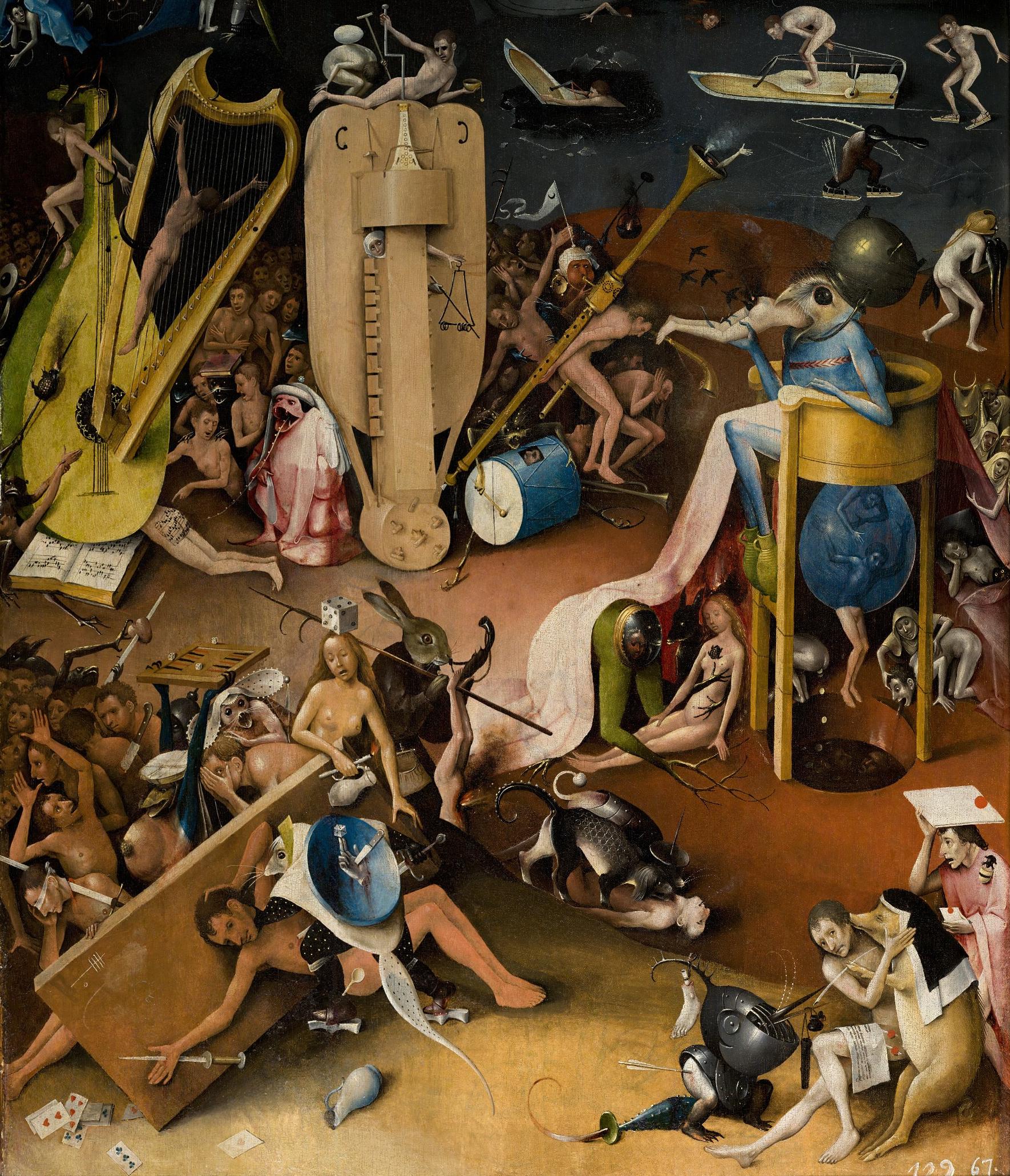
Detail of Hell The Garden of Earthly Delights.
Fear as a subject of artistic creation has been used throughout the history of art from the earliest representations of the most primitive gods, which had its antagonist, to more current artists have focused if I work on this idea of fear if it is true that in some cases, more fear nearest cinema or freak show. Some of the most recognized authors who have dealt with fear, and have exercised an influence in some ways the picture, we find from the Middle Ages, is the case of Bosch, Jeroen van Anthoniszoon Aeken, sixteenth-century Dutch painter , where one of his most famous works, The Garden of Earthly Delights is heaven, purgatory and infer, and where within the last two predominant expression of fear, resulting in a triptych, which some define as Dante while it is true that the divine Comedy would be written some years later.

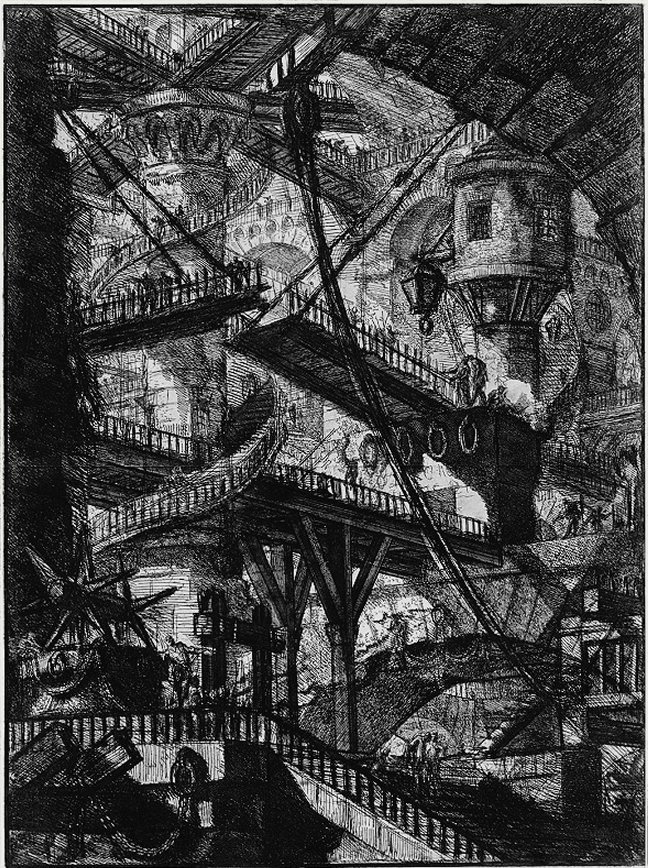
Untitled etching (called "the bridge")
Plate VII (of 16) of the series
Imaginary Prisons (Le Carceri d'invenzione),Rome, 1761
Another plastic authors to include in my previous scene photo to the invention is Piranesi, Giovanni Battista Piranesi Roman architect and writer, who during the eighteenth century, conducted a series of works, which can already be seen certain features of a primitive social fears, which with the advent of photography and the "liberation" of painting will also happen in the vanguard. It is necessary to name this period of the avant-known paintings like The Scream Edvuard Munch expressionist painter, in which the social context, which then begins to experience the psychology of Freud. takes us back to a much more social fears, fears that a primary, that is the expression of fear begins to evolve, separated by fears aside, but the primary self-imposed by society, so as to emerge, thanks to two streams of psychology at the time to understand the fear.